Sky in Motion
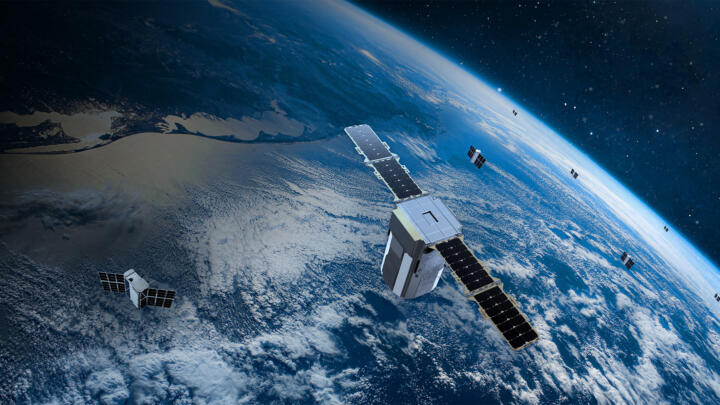
Far above our heads something is evolving that’s going to substantially change space travel. Even at this juncture, more than 14,000 active satellites are orbiting our planet – ten times more than ten years ago, and their number is increasing almost daily: In the next five years the near-Earth orbit can be expected to become the hot spot of a veritable satellite boom. Driven by initiatives from the United States and China, the number of active satellites in the so-called low earth orbit (LEO) could rapidly rise to 80,000 by 2034, according to Einstein Space Consulting – most of them at a distance between 500 and 600 kilometers (311 and 373 miles) from Earth. The expected average growth rate is a remarkable 38 percent per year – progressing at a high-speed pace that has long ceased to be determined by national space agencies. Instead, it’s private enterprises setting the pace with new approaches and innovations.
Companies like industry giant SpaceX are sending satellites into space, one after another. With Starlink, the Americans operate the world’s largest satellite network. More than 10,000 satellites ensure the existence of a worldwide broadband internet, even in remote regions. This increasing participation of private companies in space travel and space technology, combined with new technologies and business models, is called “New Space.”
Five megatrends are driving New Space
Why New Space is revving up right now can be attributed to five global megatrends. For instance, in an increasingly tense geopolitical situation, satellites are becoming an indispensable critical infrastructure for security and defense. At the same time, digitalization is driving the demand for end-to-end global connectivity. Without the orbital observation posts, our connected world would arguably be hardly conceivable. In addition, in the wake of progressive urbanization, Earth observing data as a basis for smart cities are rapidly gaining importance in terms of traffic analyses or air quality measurements.
Space to Motion
9 space tech innovations that shape our everyday lives:
The advance of autonomous systems, from self-driving cars to drones, depends on high-precision navigation from the orbit too. Not least, the New Space sector plays a key role in the fight against climate change: By 2030, satellite data could help reduce around two gigatons of carbon, according to a report by the World Economic Forum.
By 2035, the worldwide market for space vehicle engineering, i.e., satellites and launch rockets, will be growing to between 87 and about 115 billion U.S. dollars, according to various market analyses, including “Future Market Insights.” A massive decrease in costs is a key driver of this development. “The massive drop in transportation costs into orbit is one of the major game changers,” says Franz Pellkofer, the responsible project manager for New Space at Schaeffler Advanced Innovation. For about 40 years, motion technology company Schaeffler has been supplying components for space travel (see info box below) and belongs to the exclusive circle of certified suppliers for that market. The company, for instance, delivered precision roller bearings for the main engines of the launch rocket of the Artemis 2 lunar mission that successfully ended in April 2026 with the offshore landing of the Orion space capsule in the Pacific.
How space travel becomes scalable
“The costs for rocket launches have dropped by 90 percent since 2010. Today, satellites are more than 90 percent lighter than they used to be and the payloads of the new rockets are increasing five or tenfold,” Pellkofer explains. Companies like SpaceX are working on a further dramatic reduction. Long-term visions up until 2040 are reaching into ranges of less than 100 dollars per kilogram (2.2 lbs.) – in extremely optimistic scenarios even clearly below that – according to NASA.
The main enablers of these developments are reusable rockets and technological progress such as the miniaturization of satellites. “They used to be the size of a school bus and today they fit into a refrigerator – with the same or even better capacity,” Schaeffler’s expert Franz Pellkofer relates. And now they operate in so-called constellations, which opens up all new technical potential. Plus, smaller satellites not only save costs but the development time decreases as well. Standardized platforms, modular components, automated manufacturing. While satellites tended to be one-of-a-kind in the past, they’re mass-produced today. Pellkofer: “The life of such small satellites in the near-Earth orbit is reduced to about five years. After that, they burn up upon re-entering the atmosphere and are replaced by new ones. We’re experiencing a historical turning point in that respect as well.”
Facts and figures
As a result, space travel is becoming increasingly scalable. And increasingly profitable, which fundamentally changes the business model. “Satellites used to be a costly nice-to-have. Today, they’re increasingly becoming a must-have if you want to make economic use of digital data,” says Pellkofer. “The data are collected in space, while value using the business models on which they’re based is created on Earth.” Insurance companies pay a lot of money for data to calculate their premiums. In farming and forestry, Earth observance data are immensely popular too. From an orbital vantage point, you can see where soil is drying out, where plants need nutrients, or where water can be saved. Even offshore wind turbines can be monitored from space in that way.
Space travel has become a data business. A 2023 study by Roland Berger and the Federation of German Industries (BDI) has calculated that the market for space-based applications is expected to grow to over 1,250 billion euros and thus to a trillion-euro industry by 2040.

Europe in the race for the orbit
This is the new reality: Space travel is becoming an industrial market in which not only startups but also incumbent industrial companies with the requisite expertise can operate successfully. Experts are talking about a new global industry. They divide the growth of this sector into six developmental phases that are supposed to be completed in the next ten to twenty years. In phase one that we’re currently in huge satellite constellations are being created in the low Earth orbit. In phase two, robots are taking over the work in the orbit, repairing, refueling, or disposing of satellites – a completely new service market. In phase three, private space stations will replace the ISS. Research, production, and data processing will migrate to space. Phase four encompasses the development of an infrastructure in the lunar orbit. Energy supply, communications, transportation – the Moon is becoming a logistical outpost. Phase five is going to establish an initial lunar economy with local resources and industrial processes. And finally, phase six will be launched: robotic missions to Mars, followed by crewed flights, accompanied by an infrastructure that will make long-term missions possible in the first place.
So much for the rough road map. There’s plenty to be done in space.
Schaeffler in New Space
With Tech Talks, motion technology company Schaeffler has launched a new communications format in which disruptive technologies and innovations are discussed. The premiere was dedicated to the growth field that has long ceased to engage only space engineers and tech visionaries but has been calling incumbent industrial companies into action too: New Space.
“The future-focused field of New Space calls for special prerequisites in terms of technology and components, for instance regarding material processing or coatings.”
Schaeffler AG’s Chief Technology Officer Uwe Wagner
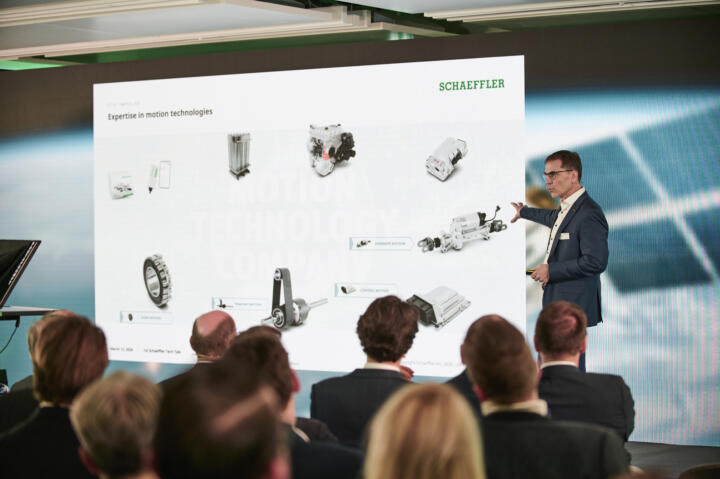
Schaeffler has not just recently recognized the enormous potential of rapidly changing space travel. For the globally active group with well over 40 years of space expertise (bearing solutions for turbo pumps, flywheels, etc.) New Space is not uncharted territory but an opportunity to contribute long-standing know-how in precision, material engineering, and manufacturing excellence to the growing space market.
In his keynote, Schaeffler AG’s Chief Technology Officer Uwe Wagner highlighted what industrial requirements the New Space growth field specifically entails. During his talk, he focused particularly on Schaeffler’s expertise in the production of high-precision components, mechatronic systems, and in the areas of sensors and control systems – capabilities that in space are required under completely different conditions than on Earth. “The future-focused field of New Space calls for special prerequisites in terms of technology and components, for instance regarding material processing or coatings,” explains Wagner.
A look at Schaeffler’s technology portfolio shows what the pathway from an idea to a marketable solution can look like. “Schaeffler already has a large part of the key technologies as the basis for complete satellite subsystems in the portfolio of its eight product families – from precision bearings to brushless direct current motors to sensors and mechatronic integration. Together with our automotive expertise, we can now manage the transformation toward more complex sub-systems including control-motion features,” says innovation manager Franz Pellkofer, the project manager for New Space.
Schaeffler sees clear opportunities in the growth of the New Space sector: Many key technologies that are required there have been part of its core business for decades. This is particularly evident in the case of the reaction wheels – inconspicuous but indispensable flywheels that stabilize satellites and for which Schaeffler is already supplying special precision bearings today. “Without reaction wheels, there’s no Earth observation, no navigation, no communications,” Pellkofer explains. Based on initial investigations, Schaeffler is examining potential partnerships with space companies and ESA consortiums in order to not only deliver individual components but to offer complete subsystems for satellites.
Pellkofer comments that “Schaeffler develops durable, maintenance-free components ensuring reliability even under harsh conditions while considering environmental aspects as well. The harsh conditions in space require utmost precision and reliability. Our decades-long expertise in material technologies, surface treatment, thermal management, and functional safety enable top-class products ensuring maximum usability of the total systems.”
This means that Schaeffler transfers proven mass production processes from automotive and industrial production to the space market. “We deploy motion to where it enables the greatest progress,” says Pellkofer. At the same time, terrestrial applications benefit from that as well. Insights gained in terms of friction minimization and material resilience are fed back into electric mobility, robotics, or industrial manufacturing.
Cooperation with a satellite specialist
Schaeffler and U.S. satellite specialist Spire Global are planning to establish an independent European space infrastructure – a letter of intent has already been signed. Schaeffler contributes its precision experience, Spire its satellite expertise. Initially, the collaboration will be about subsystems for satellites as well as high-frequency and environmental sensors, the long-term objective will be an independent European business field for space hardware and missions – usable on a large scale for defense, weather, civil security, and critical infrastructure.
Since 2013, Spire has taken more than 240 satellites into orbit with more than 40 rocket launches and is currently manufacturing 300 to 400 per year, in Munich since 2025, among other locations.