From a server farm to an energy ecosystem
Classic data centers are increasingly changing from plain-looking server facilities into integrated energy and infrastructural ecosystems. Around the world, new concepts are currently emerging that show what digital factories might look like in the future.
Under water instead of on green fields
A particularly spectacular project is that of the Chinese company Shanghai Hailanyun Technology off the shore of Shanghai where the world’s first underwater data center operating with green offshore wind power was launched this year. At a depth or around 35 meters (115 feet) on the seabed as many as 2,000 servers are soon supposed to start running with the water serving for natural cooling. Due to the use of the ambient temperature, the energy required for cooling decreases considerably.
“For an undersea data center of the same scale, the electricity used for cooling would only account for about one-tenth of total power consumption.”
Professor Li Zhen (Tsinghua University)
An onshore data center typically needs between 25 and 40 percent of its energy for water cooling. “For an undersea data center of the same scale, the electricity used for cooling would only account for about one-tenth of total power consumption,” says Professor Li Zhen from Tsinghua University, one of the project partners. The cooling power consumption for a project of this scale could be reduced to about 30 billion kilowatt hours, according to estimates. That would equate to annual savings of about 50 billion kilowatt hours of electric power.
The Chinese underwater data center is still operating with a capacity of 2.3 megawatts. However, in the long run, an extension to 24 megawatts is planned.
Microsoft pioneered the idea
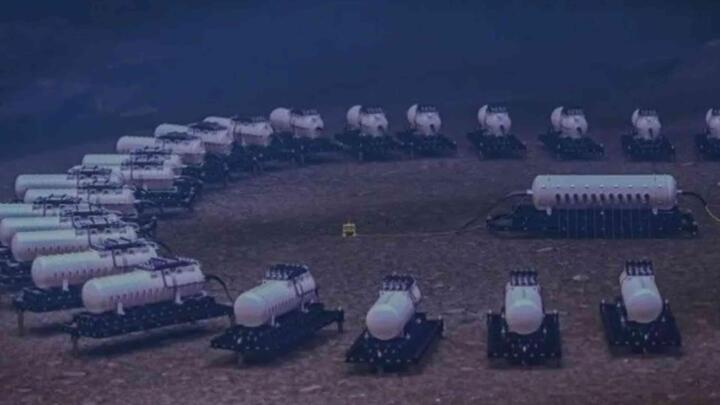
The idea of an underwater data center is not completely new. As early as in 2018, Microsoft as part of the Natick project submerged a data center off the coast of the Scottish Orkney Islands. The twelve meter (40 feet) long underwater cylinder accommodated 864 servers and had a data storage capacity of up to 27.6 petabytes. Microsoft later found that under water there were fewer hardware failures than in comparable onshore data centers. Despite technical successes the project was discontinued. In addition to changes in business priorities, high maintenance and service costs are regarded as reasons for the project having been abandoned.
Even so, the technology is just at the beginning of its evolution. While underwater data centers promise to deliver benefits in terms of space requirements, cooling, and fresh water consumption, several questions remain unanswered. For instance, there’s only little experience with the long-term operation of such facilities. In addition, researchers are investigating what effects the continuous release of heat might have on local marine ecosystems.
Facts and figures
Quellenangabe: IEA
The era of “AI factories” has begun
The era of classic data centers seems to be ending – at least in the industry’s vocabulary. NVIDIA CEO Jensen Huang is deliberately talking about “AI factories” today instead of data centers, stating that modern AI infrastructures no longer merely store data but generate a new output – digital intelligence. Data and energy are transformed into models, predictions, and decisions.
The dimension of that development is immense. According to estimates of the International Energy Agency (IEA), modern AI data centers frequently need capacities of 100 megawatts or more. The largest planned facilities are already in the gigawatt range – a scale that in the past tended to be typical of powerplants.
Consequently, the bottleneck is increasingly shifting from hardware to energy supply. That’s why NVIDIA is talking about “co-designed systems:” computing power, electric power supply, network technology, and cooling are no longer being planned separately, but developed as an integrated total system.
This change is particularly evident in terms of cooling. With the coming Rubin generation, NVIDIA is using a fully liquid-cooled architecture for the first time. The liquid coolant can circulate at a temperature of up to 45 degrees centigrade (113 degrees Fahrenheit) – clearly warmer than in conventional data centers, thus largely avoiding the use of energy-intensive chillers and cooling towers in many regions. According to NVIDIA, the water consumption for cooling is decreasing from the previous roughly 2.6 million gallons (9.8 million liters) per megawatt and year to nearly zero. The heat is picked up directly on the chip and dissipated via closed liquid circuits.
The magnitude of the capital expenditures reflects the significance of this development. Huang talks about a worldwide market for AI infrastructure in the range of several trillion U.S. dollars. Consequently, the data center of the future is becoming less of a building full of servers and increasingly a highly integrated energy, cooling, and production system.
Schaeffler makes data centers more efficient
Schaeffler supports data centers with a broad portfolio of bearing, monitoring, and system solutions. The goal is to lower energy consumption for cooling, reduce maintenance requirements, and prevent unplanned downtime.
Read here to learn how Schaeffler increases the reliability of data centers, in part through the use of electrically insulated bearings.

The world’s largest data centers
The north as a natural chiller
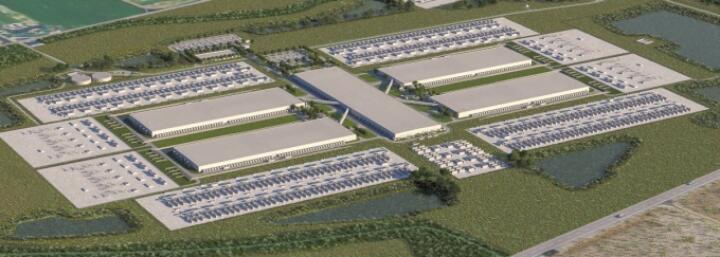
Scandinavia, Iceland, or Northern Canada benefit from a natural location advantage: low outdoor temperatures. There, many data centers can be cooled by outdoor air for large parts of the year – which is clearly more energy-efficient than classic air conditioning systems.
Meta in Northern Sweden is a prominent example. The data center in Luleå is located only about 100 kilometers (62 miles) south of the Polar Circle. The average annual temperature of about two degrees centigrade (36 degrees Fahrenheit) enables free cooling nearly all year long. At the same time, the electricity is generated largely by hydro- and wind power. Google, too, operates one of its most efficient European data centers in Hamina, Finland, where water from the Baltic Sea is used for cooling.
The sites are chosen according to the laws of physics. Google justifies the choice of Hamina as the site of its data center like this: “Google’s Hamina data center in Finland leverages the region’s naturally cold climate to operate highly efficiently. By utilizing cold seawater from the Gulf of Finland for its cooling system and capturing server waste heat for the municipal district heating network, the facility combines sustainability with cutting-edge tech.” The simple formula is that where nature assumes some of the cooling capacity, energy consumption and operating costs go down.
Floating server farm with added benefits
Optimal Transit is designing offshore vessels that combine power generation, seawater desalination, and an AI data center. At the heart of the system is a modified ocean thermal energy conversion (OTEC) plant: Warm surface water (at least 25 degrees) vaporizes ammonia, which drives a turbine; the waste heat from the servers increases the steam pressure, and cold deep-sea water condenses the ammonia vapor back into liquid—and the cycle begins anew.
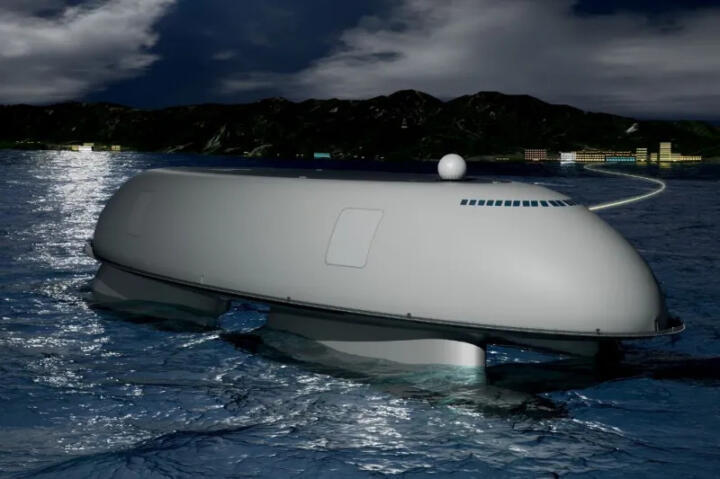
Planned capacity per ship: 40 MW of electricity (enough for approximately 32,000 households), 30 million liters of drinking water per day (enough for 150,000 people), and 60 MW of power for up to 6,000 AI server racks. The ship (91 m long, 50,000 metric tons) is connected to land via a quick-disconnect system and can undock and sail away autonomously in the event of a storm. If necessary, multiple ships can be coupled together.
Cost estimate: approximately 587 million U.S. dollars per ship. According to the manufacturer, this would not only be cheaper than comparable onshore facilities (750 million–1.33 billion USD), but also faster to implement (3 years instead of 6–10 years). Another advantage: Since no water is drawn from the body of water being used for direct cooling, the temperature there does not rise significantly.
Whether such ships will become a reality depends largely on the development of the thermal efficiency of the planned ocean thermal energy conversion plant. Due to the enormous pumping power required, test plants have recently achieved efficiencies of less than five percent—far too low for practical application.
Not welcome everywhere
As impressive as the technical innovations are – the extension of data center infrastructure is increasingly meeting with resistance. Especially in the United States, citizens’ initiatives are forming against new large-scale projects from Amazon, Google, or other tech companies.
Their criticism primarily targets the massive electric power and water consumption, surface sealing, noise pollution, and special taxation for operators. Take Meta for example: The tech corporation is receiving tax breaks of more than 3.3 billion U.S. dollars for its planned “Hyperion” AI data center in Louisiana with a project volume of over 10 billion U.S. dollars.
The argument of the project opponents: The data center could require nearly 20 percent of Louisiana’s entire power consumption while only about 300 to 500 permanent jobs are expected. Meta on the other hand refers to capital expenditures for infrastructure and renewable energies.
Clearly, the AI boom is increasingly turning data centers into a question of infrastructure – and thus into places where energy, efficiency, and technology have to be reimagined together.


