Built with sunlight
Cement can be found everywhere: in floors, walls, ceilings, and sometimes even in the minds of researchers – albeit in a positive sense. Researchers at the German Aerospace Center (DLR) are working on a method for eco-friendly production of cement. With concentrated solar radiation, the energy-intensive process for producing our most important construction material is supposed to become clearly more climate-compatible in the future.
The cement industry is one of the greatest CO₂ emitters worldwide. Around eight percent of the global greenhouse gas emissions emanate from cement production. Some 60 percent are the result of the calcination of limestone. Classic calcination, an important step in cement production today, is performed nearly almost completely by means of fossil fuels. The CemSol project aims to replace this process with solar thermally generated high-temperature heat and binding CO₂ at the same time, using a closed loop called calcium looping (CaL). That would allow the continuing use of the irreplaceable construction material cement. Cement is the most frequently traded product worldwide in terms of volume.
What exactly is cement?
Cement is a finely ground binding agent that chemically reacts with water and hardens in the process. It mainly consists of finely ground clinker brick produced from limestone and clay plus other additives like gypsum (to regulate the binding time) and possibly admixtures like slag or fly ash. Cement is a raw material whereas concrete is a composite material consisting of cement, water, and additives such as sand and gravel. Cement acts as a “glue” combining the components to create a firm construction material. In a nutshell: cement is a component of concrete – concrete is the finished material.
The production of every ton of cement causes roughly half a ton of CO₂. With CemSol, more than 90 percent of CO₂ emissions could be avoided from calcination, depending on the location of use – without changing the cement quality. Plus, the calcination process is truly a material loop: it produces no waste and no loss. Calcium oxide turns into calcium carbonate again that is calcinated anew.
Facts and figures
With the power of the sun
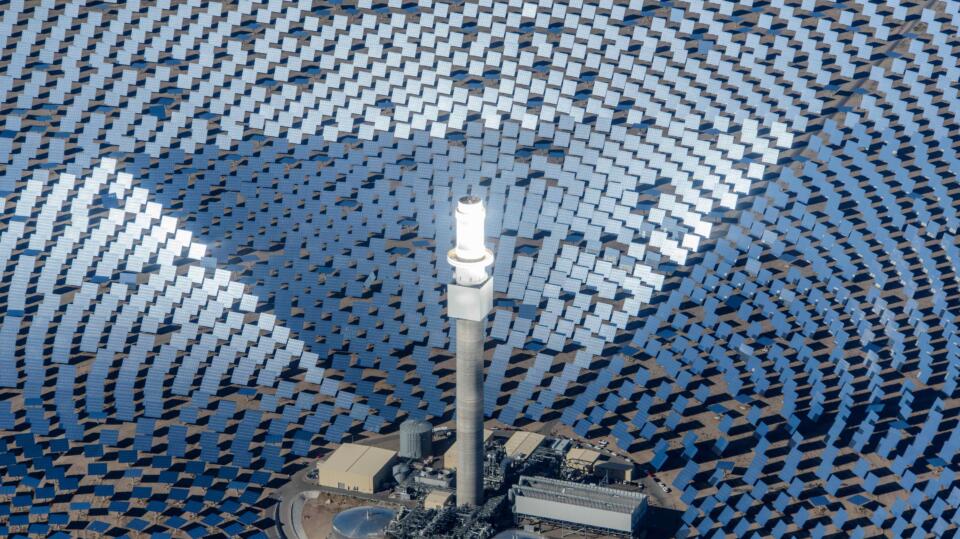
DLR studies have already shown that concentrated solar-thermal radiation can be one of the lowest-cost highest-temperature heat sources. Consequently, the utilization of solar energy directly reduces the dependency on costly and harmful fossil fuels. In addition, this technology is a highly attractive alternative to electrically heating the material, preventing a potential bottleneck in the electrification of industrial settings. The technology can also strengthen the competitive advantage of German machine manufacturers in the global market for sustainable solutions in the high-temperature sector. In the European Union, deployment in the more southern regions would be particularly attractive.
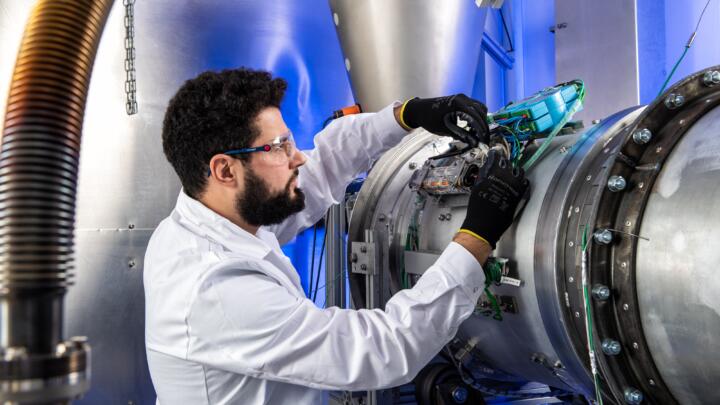
“The key to a more climate-friendly use of our resources lies in a mix of different energy sources. Concentrated solar energy can be used efficiently for high-temperature applications and bring us one step closer to this goal in conjunction with electricity from renewable sources,” says project leader Gkiokchan Moumin from the DLR Institute for Future Fuels.
As part of the project, the DLR set up an experimental test system simulating solar calcination, the core component of the process, on an application-oriented scale. It was focused on validating the reactor concept for the solar calcinator, using artificially generated, concentrated sunlight of the DLR’s sun simulator Synlight.
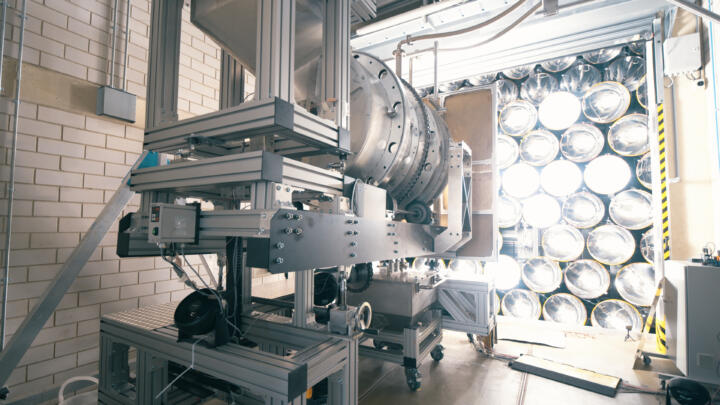
A full calcination of the 1,570 kilograms (3,461 lbs.) of limestone used in the project and subsequent sintering (fusion) would yield almost the same amount of cement and six times as much concrete, enabling a square hut with a footprint of five square meters (54 square feet) to be built.
In the multi-month test campaign, a total of 25 radiation tests with outputs of up to 65 kilowatts were run, representing the so far largest calcination system. Per hour, 15 to 50 kilograms (33 to 198 lbs.) of limestone particles were fed into the solar calcinator and fully calcinated. In total, the researchers extracted more than 90 samples of the calcinated limestone that they are now going to analyze in detail to assess the material quality and long-term stability of the process. In addition, they’re going to examine the reactor by means of computer simulations in terms of thermal transportation and the reaction of the limestone particles. The data gained in that way will provide the foundation for the further development and higher scaling of the technology.
Cement production and solar energy: Schaeffler’s role in that regard
- While the DLR demonstrates how solar energy can make cement more climate-friendly, motion technology company Schaeffler shows how precision technology enhances the efficiency of solar systems. How? So-called tracking systems cause solar modules to follow the sun during the day to increase the energy yield by up to 40 percent. The mobile assemblies of the photovoltaic systems in the best case must be designed for robustness, compactness, and low maintenance. Precision and durable Schaeffler components reduce failures, thus enhancing the efficiency of PV systems. Click here to learn more.
- For Schaeffer, machines in cement production are a strategic business in the field of rolling bearings. Schaeffler can provide suitable and reliable rolling bearings for all needs in material conditioning. Click here for further information.
- In addition, read here how Schaeffler by deploying condition monitoring technologies in cement plants ensures reliable processes and minimal downtimes.


