How precise can predictions be for the world of tomorrow? Two approaches are conceivable to come up with an answer: The first one looks back – on the forecasts for our current present that were ventured around the year 2000. It shows how close or not former ideas of the future came to reality. The second approach looks ahead – to scenarios that a researcher today is mapping out for the year 2050.
“Predictions aren’t easy especially when it comes to the future,” according to a Danish joke from the 1950s that hasn’t lost any of its relevance if we’re honest. Even so, that has never kept people from trying to make them anyway. Someone who was a particularly good clairvoyant was science fiction author Jules Verne who in his 1863 novel “Paris in the Twentieth Century” described glazed skyscrapers, air conditioning systems, television sets, or fax machines. By the way, Jules Vernes’ publisher found the book to be so bad back then that he didn’t want to publish it. In addition, in a letter to the novelist he wrote, “People will never believe in your predictions.”
Wrong. But let’s see what predictions were made for today around the turn of the millennium.
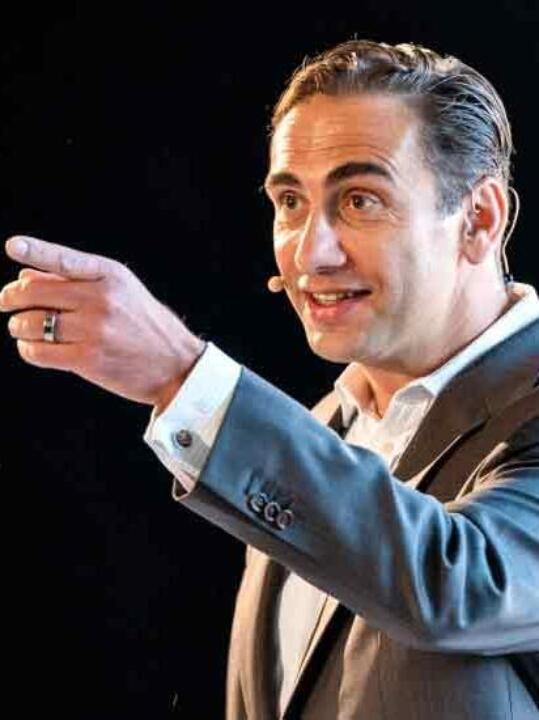
Sven Gábor Jánszky is a futurist and CEO of 2b Ahead ThinkTank in Leipzig. “tomorrow” asked him how people are going to live in 2050.
Mr. Jánszky, what will a day in 2050 be like? One thing for starters: Working at our institute are PHD futurists that use scientific methods. With them, it’s possible to predict about ten years, that’s all. Anything beyond that is speculation. If I had to speculate, I’d say that I don’t believe that the course of a day would change fundamentally. Clearly, we’re going to live in times where technologies like artificial intelligence and robotics will have reached a level of intelligence that’s clearly above human intelligence. AI and robots will be taking over most processes of what we call working life today and replace many of today’s jobs.
So, what are we going to do all day? People will be getting up and spending the morning with social work, for instance by helping in schools or passing on knowledge, albeit not completely unconditionally but as a contribution to society. After that work on one’s personal self-actualization begins, encompassing sports and health as well as purpose and spirituality.
“Everyone is going to have their own AI. People will be talking to their own digital double.“
How are we going to live with AI in everyday life? Everyone is going to have their own AI. It will be dedicated agents, in other words personal assistants, maybe three to five, that communicate among each other and know their human in great detail. We could say: people will be talking to their own digital double. The person will have an agent as a contact and personal digital companion.
Will smartphones in their current form continue to exist? No, they’re going to disappear. The visual function will migrate to headsets. The auditive function is already shifting to small, inconspicuous devices. This is heading in the direction of integrated systems that we know from science fiction.
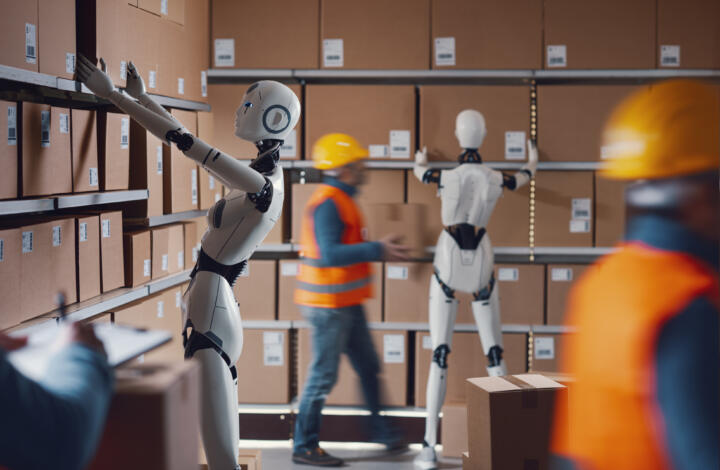
And how are we going to live? There will hardly be any change in that respect. However, the biggest change within residential settings will be humanoid robots, in other words robots that look like humans and can do various jobs like cleaning, cooking, providing security, playing with kids or pets, taking over nursing jobs, or serving as conversation partners. I call them the “new cohabitants.”
You just mentioned nursing care, now we are getting older and older. Yes, there’s a steep rise in the percentage of older people. We’re assuming that many people will live to be around the age of 120 while remaining mobile and capable for longer periods of time. Aging will slow down. There are approaches already to influence the biological age. In terms of society, that primarily changes the structure: birth rates decline while the total population tends not to continue to grow. And the end-of-life shifts more into the realm of personal choices. Moreover, people are going to stay active longer.
A final question: Personally, to what are you looking forward the most when looking into the future? To a world with adequate energy. Having more energy than we need changes everything. In fact, that scenario was described only once in “Star Trek,” as a world in which anything can be produced at any time and money no longer matters. That’s not a prediction but I do find the idea of perhaps being able to experience something like that very fascinating.
Author
Wiebke Brauer
Wiebke Brauer, who serves as the senior text editor of cult car magazine “Ramp,” among other things, has always been interested in the major questions concerning the future. For this text, the native of Hamburg compared past predictions with future scenarios – and learned that the future cannot be calculated but with the right paradigm shift can be surveyed with amazing accuracy.