Youth provides motion
People want to be mobile – now and going forward. Despite all chatrooms, social media offerings, options to work from home, or metaverses, the desire to discover the real world, to interact with real people, for social integration, and physical access to education and careers remains. But the ways in which people are going to move between A, B, and C in the future is going to be resorted – driven by climate goals and changing social factors.
In their report titled “The Future of Mobility,” McKinsey Consultants even conclude that in the next decade the mobility ecosystem more than likely is going to undergo a transformation the world has never seen since the early days of the automobile. And one of the key changes will concern exactly that: the automobile. Privately owned passenger cars are still dominating the global mobility patterns: People still cover some 45 percent of all distances with their personal cars. However, this model is increasingly coming under pressure. A large part of the predictions assume that the global passenger car market will be experiencing its historic sales peak before the end of this decade and subsequently shrink successively. Especially a large number of young people couldn’t care less about cars. Or more specifically, a car of their own. That trend is clearly discernible right now. According to the survey titled “Europe’s Gen Z and the future of mobility,” only 42 percent of people below the age of 30 are still using a privately owned vehicle on the old continent as opposed to 77 percent of those above 45 that still are.
Schaeffler as a partner for new mobility
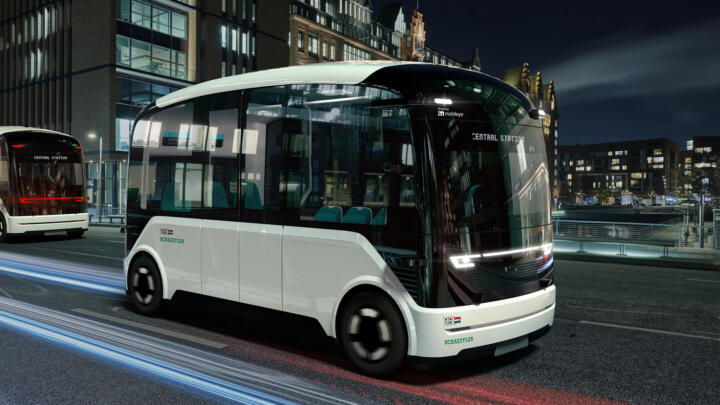
They’re an important part of the future of mobility – and already being deployed in tests in a growing number of big cities: autonomous robo-taxis that users can hail by means of apps. Amazon’s subsidiary Zoox, for instance, after Las Vegas and San Francisco, is planning to serve Austin and Miami as well with their proprietary mini bus developments. Other metropolises like Singapore, Toronto, Dubai, or Hamburg are running pilot projects of various providers and vehicle manufacturers as well. Experts predict that the demand for driverless shuttle services will rapidly increase in the next few years especially in many big cities in Europe, North America, and parts of Asia. Schaeffler is already very actively involved in shaping this development as a supplier of highly integrated electric powertrains and steer-by-wire systems and as an expert development partner of modular vehicle platforms. This development and manufacturing expertise is intended to help produce shuttle vehicles on an industrial scale to make them available sooner.
From ownership to use
Even so, the automobile will maintain its leading role in future mobility worlds as well – except it’s going to do so in different ways – no longer as a status symbol in people’s personal garages being parked without being moved most of the day but in constant motion as part of a shared mobility world. However, due to the growing level of automation in automotive cockpits, car sharing will increasingly be turning into ride sharing, where self-driving cars are going to collect passengers and take them to their destinations 24/7.
The trend that’s been emerging with cars is gaining traction in other vehicle classes as well: using without owning. Even at this juncture, only one in three people below the age of 30 can imagine owning a car in the future, according to a McKinsey GenZ Mobility survey run in Germany, France, and the United Kingdom. For many young people, that’s not a loss but a gain in flexibility. Analyses assume that mobility via offerings revolving around cars will be evolving into an integrated “Mobility-as-a-Service” (MaaS). By 2040, up to 30 percent of the transportation capacity could be delivered by digitally organized offerings.
In many metropolitan areas, the MaaS offering of local public transportation has already been rolled out in large parts via rental bikes, scooters, and cars all the way to ride hailing companies such as Uber, Bolt, Lyft, or Moja and is frequently being used especially by young people. In the past, young people with their open-mindedness toward new technologies helped cell phones, chat programs, social media, gaming, or online banking to become successful, and now new mobility offerings are reaping the benefits. Not least due to the pioneering work of the young users, analysts are predicting huge growth potential of some 30 percent per year in the coming decade.
The mobility of the future, above all, must be smart and affordable
The open-mindedness toward technology and new forms of mobility of the U30 generation is also evidenced by a survey of the ADAC Foundation among 16- to 27-year-olds in which 44 percent supported the wide-spread utilization of self-driving vehicles and digitally connected mobility offerings in everyday settings. 43 percent advocated electric mobility, 36 percent supported air taxis. 25 percent would like to have more stops with a variety of mobility offerings, so-called multimodal transportation hubs. All of these responses are above the approval ratings of the total population. Especially compared to baby boomers, Gen Z is clearly more inclined to adopt new technologies.
The next dimension of urban mobility
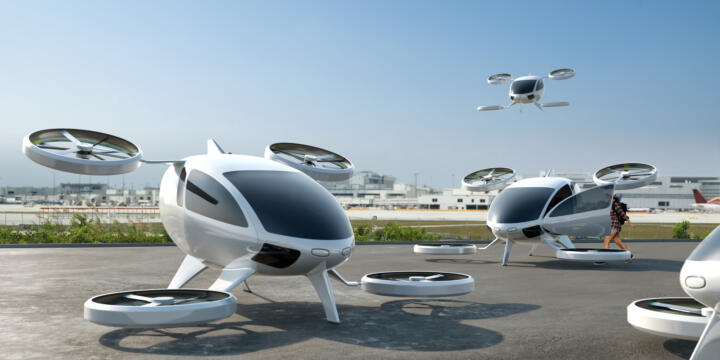
The biggest paradigm shift in the field of transportation: Mobility leaves the road. Today, cities are organized in two-dimensional ways – roads, rails, sidewalks. So-called Urban Air Mobility (UAM) develops the airspace as the third level. New “air corridors” are going to relieve the load on classic traffic routes. However, current studies show that UAM will initially cover only a small portion of all routes, so that the overall effect on traffic jams will be limited at first. Nevertheless, mobility researchers like Dr. Andreas Hermann from the University of St. Gallen are pinning high hopes on UAM. He says that the “airspace offers new opportunities to ease the increasing pressure on urban transportation infrastructures. Electrically powered air taxis and drones are supposed to quickly cover short distances and take the edge off urban traffic problems.” This new technology is another one that younger generations are clearly more inclined to accept than older ones. If parameters such as price, safety, and – above all – social acceptance are right, a best-case prediction by the German Aerospace Center says that air taxi transportation using commercial air taxis could significantly increase by 2045 with up to 190 million flights per day by 2050, distributed to 200 metropolitan areas focused on Asia, Oceania, Europe, and North America. Especially due to its extensive expertise in the field of electric powertrains, UAM opens up an attractive business field with major growth potential also for Schaeffler.
At the same time – and perhaps somewhat more surprising – empirical investigations in the field of young mobility show that sustainable options would only be adopted if they were both convenient and affordable. Consequently, the future is not going to belong to “green” mobility alone but to a type of mobility that’s equally practical, affordable, available, and sustainable.
City vs. country: two speeds of transformation
And this trend is intensifying as well: The future of mobility will not be homogeneous. While cities are becoming highly connected mobility spaces, rural areas will remain structural exceptions. By 2050, some 70 percent of the world population are going to live in cities where multimodal systems from micromobility to fully automated trains will emerge. Urban transportation will be data-driven, personalized, and increasingly autonomous.
At the same time, a mobility gap is threatening to affect urban areas because the sparse population density makes economical offerings more difficult. Autonomous on-demand shuttles (see also page 27) could mitigate the situation but their introduction heavily depends on government funding and infrastructural investments. In a nutshell: while cities are reinventing mobility, rural regions need to first secure it. And currently, that means that without automobiles there’s little moving forward in the hinterland of most industrial nations. A look at Austria shows that as well: in the big city of Vienna, only one in five people is still getting a driver’s license compared to 55 percent of people in the rural Burgenland.
How early mobility shapes lifelong patterns
A frequently underrated yet decisive factor of developments in mobility is socialization in everyday transportation settings. Numerous studies show that the means of transportation that people use and learn to use in their youth have a sustainable effect on their behavior later in life. Mobility is not only a functional matter but culturally and emotionally defined.
When young people grow up with a well-developed public transportation system or many sharing opportunities, those are anchored in their minds as being “normal.” For good reason, the OECD emphasizes that the mobility habits of young people may be decisive for sustainable developments in society and in terms of sustainability.
“Young people should be actively involved in planning and decisions on transport-related issues.”
Demand by the OECD International Transport Forum
Specifically, that means that people using buses, trains, or bicycles at an early age are highly likely to do so as adults as well. However, those being socialized in car-centric regions will often stick to using privately owned automobiles. That correlation intensifies existing differences between urban and rural areas and illustrates that the transformation of mobility is decided not only technologically but also socially. Today’s infrastructure shapes tomorrow’s behavior. Professor Andreas Hermann, a mobility expert at the University of St. Gallen, emphasizes that as well by saying, “In many cases, the technology is not the main obstacle to the acceptance of new products but our own habits.”
That’s another indicator showing that today’s young people are assuming a key role in the development of future mobility. Even so, it typically hardly plays a role in transportation planning. Young people are rarely asked to contribute their ideas and needs to mobility projects, much to the chagrin of many mobility experts. The international Transport Forum of the OECD, for instance, demands that “young people should be actively involved in planning and decisions on transport-related issues. Creating youth advisory committees and engaging youth organizations will ensure their voices are heard and their specific needs are considered.” That’s all the more important as acceptance by the young target group is a decisive factor in deciding if mobility offerings from autonomous driving to air taxis will be adopted in everyday life or whether in the end only cars are going to reliably deliver us to our destinations because true alternatives are lacking.


